
Purpose
Performs Strongly Connected Components (SCC) decomposition. It partitions and groups the graph into cyclable components, and creates a DAG of those components.
Example
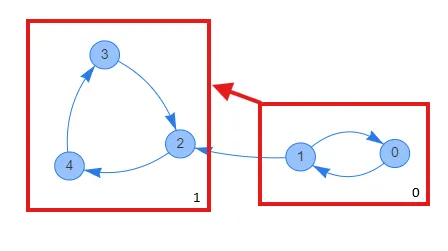
In the figure above, movement is mutually possible within group 0 and group 1 respectively, and movement between groups is only possible from group 0 to group 1. Intuitively, it is graph compression.
Time Complexity
Usage
Declaration
auto res = scc(g);g is a vector<vector<int>>.
Get the index of the strongly connected component to which vertex i belongs using res.indexToContracted[i].
Get the graph grouped by strongly connected components using res.contractedGraph (vector<vector<int>>).
The execution result for Example is:
res.indexToContracted = { 0,0,1,1,1}res.contractedGraph = { {1}, {}}.
Implementation
struct scc_return { vector<vector<int>> contractedGraph; vector<int> indexToContracted;};scc_return scc(const vector<vector<int>> &_g) { vector<vector<int>> gg(_g.size()), rg(_g.size()), contracted; vector<int> comp(_g.size(), -1), order, used(_g.size()); for (int i = 0; i < _g.size(); i++) { for (auto e : _g[i]) { gg[i].emplace_back(e); rg[e].emplace_back(i); } } auto dfs = [&](auto &&self, int idx) { if (used[idx]) return; used[idx] = true; for (int to : gg[idx]) self(self, to); order.push_back(idx); }; auto rdfs = [&](auto &&self, int idx, int cnt) { if (comp[idx] != -1) return; comp[idx] = cnt; for (int to : rg[idx]) self(self, to, cnt); }; for (int i = 0; i < gg.size(); i++) if (!used[i]) dfs(dfs, i); reverse(order.begin(), order.end()); int ptr = 0; for (int i : order) if (comp[i] == -1) rdfs(rdfs, i, ptr), ptr++; contracted.resize(ptr); for (int i = 0; i < _g.size(); i++) { for (auto &to : _g[i]) { int x = comp[i], y = comp[to]; if (x == y) continue; contracted[x].push_back(y); } } for (auto &v : contracted) { sort(v.begin(), v.end()); v.erase(unique(v.begin(), v.end()), v.end()); } return {contracted, comp};}